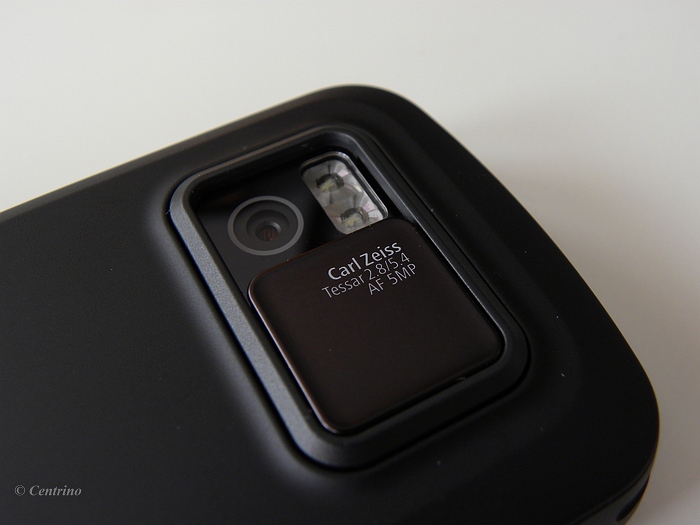
Over at the S60 Blog, Carlton has posted his test images that he’s snapped on the N97.

There’s also a video, and Carlton reckons everything is ‘crisp and clear’. But what do you think of the camera performance? Jump over and let him know.
Over at the S60 Blog, Carlton has posted his test images that he’s snapped on the N97.
There’s also a video, and Carlton reckons everything is ‘crisp and clear’. But what do you think of the camera performance? Jump over and let him know.
Michael Sherlock has out his thoughts about the N97 down on video. It makes for an excellent beginner’s guide to the device Make a drink, sit back, enjoy:
Head over and leave him a comment.
Chris Kuzma has realised that being a part of the Teach The Technophobe challenge has served only to present him with a dilemma.
He reckons he’s ‘begun to adore’ the E75 and will be reluctant to return to the E71 (despite its many benefits - ‘more tactile keyboard, crisper performance’, sleeker design). He’s also hankering after an N97, but seemingly only as a stop gap until he gets his hands on an N86. He seems truly torn, do you have any advice for him? Jump over and let him know what you think.
Well the Nokia N97 is one of the hottest, most feature packed devices out in the markt right now and so we decided to bring you some very hot pictures of it as well. The photos were taken by Centrinos, a good friend of mine.
Nokia N97 vs Apple iPhone 3G Pictures


Jim, from the Starry hope blog, has got his hands on an N800 and has put a video up demonstrating how Google Maps works on the device. Whilst it can’t give you your exact GPS location without the GPS receiver, you can log on, on the move and get directions. Jump over to see and comment.
PhonePoint is the professional wireless presentation tool.
It has been designed from the ground up as a tool for presenters; slowly fine tuned with feedback from these professionals, people for whom presentations play an essential role in their job.
Whether an occasional PowerPoint user or, if indeed, presentations are a critical part of your job, PhonePoint will give you a competitive and polished edge when delivering PowerPoint presentations. With PhonePoint you can concentrate upon just the presentation and the audience, leaving the PC well alone.
Features:
The N76 design competition is pulling some amazing talent out of the internet, the guys over at Symbian-Freak are particularly excited about the competition that lets you design your own N76 and potentially have it made.
If you want to vote for him, jump over to the thread in Symbian-Freak to get the link, there are loads of others you might prefer! Get over to Nseries yourself and enter your own.
NiceClock Lite is a "light-weight" version of regular NiceClock. "Heavy" functions that were not very claimed by customers but required significant resources and caused incompatibility problems, were removed. Other helpful features were added instead of.
New features and bonuses:
Basic Features
There are many different players like Skype, Vonage, TruPhone, Gizmo, etc. A great place to get information on all these is Andy Abramson’s blog Voip Watch.
That there are 2 ways to get the Gizmo Project application on your phone. The right way, and the wrong way, apparently. The wrong way is to use the Download! Application on the N95 (I can’t really speak for the N80). The right way, however, is to go to Nokia’s Beta Labs website and download 2 .sis files. For some reason, the application that is loaded into the Download! app only configures the settings internally on the phone. It doesn’t give you the full-blown app with IM and all the contact list integration. Why? I don’t know. Just want to make sure you’re aware
On the Phone:
From the Phone using it as a usb-stick:
offered will be Nokia N95, N73, and N70. For an additional €80 to €100 these smartphones will embed Nokia’s Smart2Go navigation software with Italian maps, a memory card, a car cradle and a Bluetooth GPS receiver (except for the N95 which is already GPS-enabled).
At the same time TIM is also offering an off-board navigation solution powered by Telenav. This demonstrates some wireless carriers in Europe have understood off-board navigation is probably not what most of customer are willing. Furthermore an hybrid solution such as Smart2Go makes use of the cell phone connectivity therefore creating value for them.
Ten years from now, Nokia’s going to be the subject of an interesting business case study. It’ll either be the stirring story of a company at the height of its power that had the courage to challenge its deepest beliefs. Or it’ll be the cautionary tale of a company that had it all and blew it.
Nokia says it’s planning for what comes after the mobile phone.
I’ve heard this from Nokia before, but I always used to think it was posturing. Companies say that sort of thing all the time — "we’re looking for the next big growth driver" or something like that, meaning they plan to keep doing all the same stuff they do today but also desperately hope they can grow another line of business alongside it. That’s typical in business; you try to have your cake and eat it too.
But after hearing several senior Nokia people repeat the message over the last couple of months, I’ve started to believe they’re saying something different. Don’t get me wrong, I’m not trying to say they are about to abandon mobile phones. But I think they sincerely believe that business won’t last forever, and they’re starting to lay the groundwork for what will replace it.
The message really hit home last month, when I heard it from Nokia CTO Tero Ojanpera and Bob Iannucci, head of Nokia Research Center, at a Nokia strategy briefing in Silicon Valley. Iannucci pointed out that Nokia started as a paper mill and has a history of completely changing its industry from time to time — from rubber boots to monitors to mobile phones. He said it is once again "a company in transition to the next phase." That next phase is mobile computing.
Not smartphones, not converged devices, but full-on mobile computers intended to replace both PCs and mobile phones. Nokia says it expects these devices to eventually sell in the billions of units, and to become the world’s dominant means of accessing the Internet.
Even though these future devices will still be mobile, if you take all of Nokia’s statements at face value the changes from mobile phones will be so extensive that it’s fair to call it a new business.
The fact that Nokia’s even talking about this is a remarkable change. Five years ago, Microsoft was charging hard in mobile and the big topic of discussion was how could a company like Nokia possibly defend itself. Now Nokia’s talking about how it will put the PC industry out to pasture, and oh by the way take over the Internet as well.
Although the goal is almost insanely ambitious, I can’t say that Nokia is wrong to try. Mobile phones are gradually becoming a commodity. The biggest unit growth is in low-end phones, a strength for Nokia because of its volumes and efficiencies. But even Nokia managers will tell you that creating low-end products in a saturating market is not a fun business. It certainly won’t produce the sort of growth and margins that investors expect.
Nokia’s not predicting the instant death of the mobile phone business. It’s a very large and divisionalized company, and I’m sure big chunks of Nokia are hell-bent on staying a mobile phone company forever. But it sounds like the senior management feels the mobile phone business is becoming uninteresting, and they want to get started on the next thing before the current business rides off into a long Nordic sunset.
The hard part is implementing
Becoming a mobile computing company is a lot harder than talking about it. The mobile phone world is based on managed competition, in which operators, handset vendors, and governments create shared standards even as they compete. It’s a closed circle in which new features flow down from the top like molasses running down a cake of ice, driven by fiat from the leading vendors.
The computing world is much more Darwinian. Barriers to entry are lower, and innovation often flows up from the smallest players. Companies compete in something that resembles a free-for-all, with the marketplace choosing winners.
So what Nokia’s talking about is not just a change in product design. It’s more like a wholesale remaking of the company’s culture, processes, and partnerships. The advantage of this for Nokia is that if it successfully makes the transition, it will have put everyone else in the mobile phone industry — handset vendors and operators — at a permanent disadvantage, unless they can make the same wrenching transition.
The disadvantage is that the change is pretty darned wrenching for Nokia as well.
Nokia seems to understand at least some of the changes it has to make in order to be a computing company. Iannucci acknowledged that the "Internet model" of product development is to create and ship products first, and then bother about standards later (if at all).
He said Nokia’s research labs, formerly fairly closed, have re-oriented themselves to work collaboratively with universities and other parties in the industry. The collaboration part is essential because "we can no longer fuel…internally" the amount of technology the company has to develop now that it wants to be a computing company.
Thus the briefing in California — they want to be a part of the peculiar hive mind we call Silicon Valley.
The transition will be awkward
One amusing example was when a Nokia speaker solicited feedback from the audience on what barriers to success they see in the mobile marketplace.
A VC shot up his hand: "Operators."
Dead silence for a second. Then the Nokia speaker asked uncomfortably, "what in particular about operators?"
And you had to laugh a bit, because the question didn’t really need to be explained. What the questioner meant was: "we want the operators dead; are you going to help make that happen?" Everyone in the room knew that. Nokia knew that. The question was a test of Nokia’s seriousness.
Nokia didn’t exactly pass the test. They won’t answer that question on stage because it creates too many political issues for the current mobile phone business. So what could have been a nice bonding moment between Nokia and the Silicon Valley folks degenerated into a carefully nuanced spiel about "we’re working together to address many issues" and bland verbiage like that. They ended the Q&A soon after.
Lesson: If you want to bond with somebody, be prepared to discuss the issues they care about. And don’t ask for feedback unless you’re prepared to answer tough questions.
Next steps
Here are some other issues that I think Nokia will need to work through if it really wants to bond with Silicon Valley.
Get real about the role of mobile computing. As far as I can tell, Nokia’s hoping that the mobile computer will literally replace PCs. I think that’s both naive and unnecessarily limiting to Nokia’s prospects. Mobile usage is a different paradigm from personal computing. You use a PC in a long sessions at a static location; you use a mobile while on the go, in places where a PC isn’t convenient. That different usage pattern means the users are likely to have different requirements and different expectations for mobiles than they have for PCs. If Nokia tries to just make mini-PCs, it’s probably going to end up with products that don’t deliver on the great new stuff that mobile computing can really do.
To give a rough analogy, if the mobile phone companies had focused only on making land lines mobile, would they have ever invented SMS?
Nurture developer communities. Nokia has a very extensive developer support organization, but I’m not yet seeing the sort of broad-scale evangelism — developer recruitment — that an Apple or Microsoft practices. To really win over the best developers, it’s not enough to just make their development tasks easy, you have to make sure they have the opportunity to make money. No one’s doing that well in the mobile space today. Including Nokia.
The mobile software companies continue to flail around trying to figure out which company can build a business opportunity worth committing to. The opportunity is there for Nokia, but it has to invest in building the market.
Manage Adobe vs. Microsoft vs. Sun. Nokia said it’s working very closely with Adobe on Apollo, the new software operating layer derived from Flash and Acrobat. The implication is that Nokia will distribute the mobile version of Apollo on its phones, just as it distributes Flash today.
There are two potential downsides to this. The first is that Adobe might lose — it’s facing strong competition from Microsoft’s Silverlight, and apparently from a revamped version of mobile Java from Sun (I’m planning to write about that one in the future). If one of the others wins, Nokia might end up deeply committed to a failing standard.
The second danger is that Adobe might win, leaving Nokia at the mercy of a mobile software standard controlled by a different company. Replacing the Microsoft monopoly with an Adobe monopoly would be delightful for Adobe, but it isn’t going to feel like much of a win for Nokia.
Learn to design solutions, not gadgets. I think this is Nokia’s biggest challenge. The most popular mobile computing products so far have been integrated hardware-software systems aimed at a single usage: GameBoy, iPod, BlackBerry, and of course the mobile phone itself. Nokia hasn’t been notably good at designing this sort of integrated system. In fact, its most prominent effort so far, the nGage, was an epic failure on the scale of the Edsel and the presidential campaign of Michael Dukakis.
But if Nokia really wants to be a mobile computing company, this is a skill it absolutely must learn. It is an incredibly hard change for Nokia, because computing systems design requires a very strong culture of product managers who understand the customer and have dictatorial control over the features and interface of the product. A good computing system is a product of idiosyncratic vision. Collectivist Nokia, with its endless conversations and responsibility fragmented across dozens of teams, is in a terrible situation to pull this off. Frankly, I’m skeptical that they can do it.
But on the other hand, if they can turn a pulp mill into a mobile phone company, would you really bet against them?


Phone guardian is a neat little security application which contains a couple of nice features. After installing to the phone, the user is required to set a master password and from the applications GUI the user is able to configure the application and set some custom parameters.
Phone Guardian for Series 60 3rd edition mobile security software is a must for your phone because:
- It secures your mobile and all data on it by locking the smartphone on SIM change or on secure SMS
- It provides automatically all possible information to find the thief and get your phone back
- Mobile can be locked automatically after the phone is some time idle, so that you do not have to worry about the security when you leave the phone. Unlock is possible only with the right password.
Phone Guardian saves permanently all information about the mobile and the SIM. This information is sent to the defined number when the SIM is changed.
Furthermore Phone Guardian allows to lock the mobile automatically or when a lock SMS is received.
Once locked the phone remains secured. It will not be possible to use your mobile or to uninstall the Phone Guardian software without knowing the password.
Key Features:
- Automatic mobile total lock on SIM change or remotely using SMS
- When locked the phone does not react on any key pressing and shows a secure message. This message can be put away only with entering the right password.
- Information that will help you to find the mobile is sent automatically per SMS on every Sim change, including the number of inserted SIM, IMSI and CellID numbers
- A very loud siren can accompany the phone lock if needed
Uninstall of Phone Guardian is possible only with password
? Phone lock remains also after phone restart
? Silent mode available: the info about the mobile can be sent without locking the phone.
Registration Information
The trial version is limited for 5 days. A license code based on IMEI is provided upon purchase.
Carol is a new one, and she’s opened up her blog with a handy post that includes some little tips which will help you get around your device. Do reply her if you know any thing else, say hi and let her know what you think.